
Corporate Governance
Basic approach
We consider achieving swift management decision-making in response to the fluctuating economic environment and increasing shareholder value through sound business management are the important issues for us. To achieve this, we are working to build strong relationships with our stakeholders, comprising first and foremost our shareholders, as well as our business partners, local society and our employees, and to enhance corporate governance as we strengthen and improve each of our functional bodies, including the Board of Directors and the Board of Executive Officers.
Changes to initiatives to strengthen corporate governance

Corporate governance system
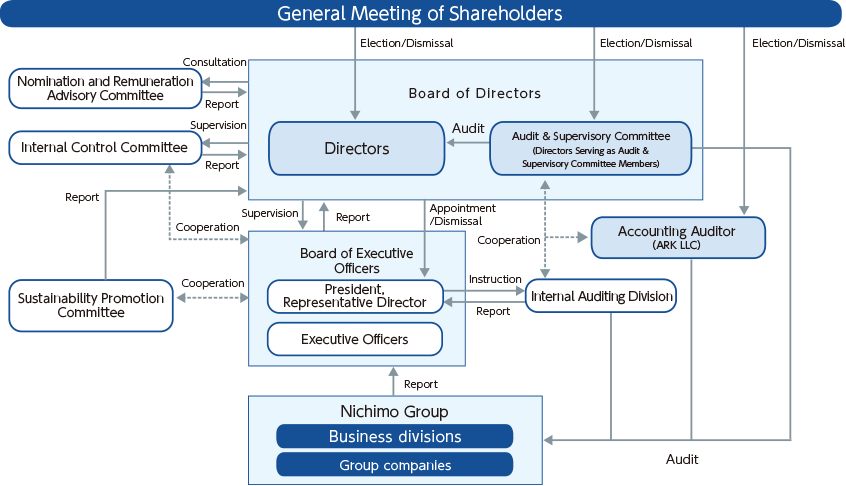
Board of Directors
The Board of Directors consists of six Directors (excluding Directors Serving as Audit & Supervisory Committee Member) and five Directors Serving as Audit & Supervisory Committee Member (four of which are Outside Directors). At its meetings, which are held once monthly in principle, important matters are determined in accordance with laws and regulations, the Articles of Incorporation and internal company rules, and the status of business execution is supervised by the Directors Serving as Audit & Supervisory Committee Member.
Results of activities
| Fiscal year | Meetings convened: Meetings with all Directors present |
|---|---|
| 2025 | 16 meetings in total: 16 meetings |
| 2024 | 16 meetings in total: 16 meetings |
Results of activities
- Important personnel changes
- Convening of the General Meeting of Shareholders as well as decisions on matters to be discussed and on proposals to be submitted to the General Meeting of Shareholders
- Approval of financial statements and their supplementary details, etc.
Audit & Supervisory Committee
The Audit & Supervisory Committee consists of the five Directors Serving as Audit & Supervisory Committee Member (four of which are Outside Directors) and holds meetings once monthly in principle. The Committee rigorously audits the execution of duties of the Directors (excluding Directors Serving as Audit & Supervisory Committee Member) and the Executive Officers, and diligently exchanges information with the administrative sections such as the Internal Auditing Division and the Accounting Auditor.
Results of activities
| Fiscal year | Meetings convened: Meetings with all Committee Members present |
|---|---|
| 2025 | 14 meetings in total: 14 meetings |
| 2024 | 14 meetings in total: 14 meetings |
Results of activities
- Exchanges of information with the Representative Director
- Exchanges of information with Directors, etc.
- Exchanges of information with the presidents of Group companies, etc.
Nomination and Remuneration Advisory Committee
The Nomination and Remuneration Advisory Committee has been established as an optional advisory committee to the Board of Directors. It consists of five Directors (four of which are Outside Directors). The aim of the Committee is to obtain the appropriate involvement and advice of Independent Outside Directors to strengthen independence, objectivity and accountability, and to further enhance our corporate governance system when nominating Directors, determining important matters relating to remuneration, and so forth.
Results of activities
| Fiscal year | Number of meetings held |
|---|---|
| 2025 | 2 |
| 2024 | 2 |
Main matters resolved
- Matters regarding the appointment/dismissal of Directors
- Matters regarding the appointment/dismissal of Executive Officers
- Details of Director remuneration, etc.
Sustainability Promotion Committee
The Sustainability Promotion Committee is chaired by the President and Representative Director and consists of members selected by resolution of the Board of Directors. This Committee formulates a sustainability policy, identifies material issues (materiality) based on this policy, sets targets and reviews progress, and reports regularly to the Board of Directors.
Results of activities
| Fiscal year | Number of meetings held |
|---|---|
| 2025 | 4 |
| 2024 | 4 |
Main matters resolved
- Matters related to the formulation and revision of sustainability policy
- Identification of material issues (materiality) based on sustainability policy, setting of targets and review of progress, etc.
Independence criteria and qualifications of independent Outside Directors
The appointment of independent Outside Directors is based on the requirements for Outside Directors set forth in the Companies Act and the independence standards stipulated by the Tokyo Stock Exchange. Additionally, the Company appoints as Outside Directors individuals (candidates) who have extensive knowledge and experience from years of work experience at other companies and who will oversee the legality and appropriateness of management of the Company and contribute to further improving the corporate governance system.
Reasons for appointment of independent Outside Directors
| Name | Reason for appointment |
|---|---|
| Tatsuya Kikuchi (Audit & Supervisory Committee Member) | Mr. Kikuchi was appointed based on his extensive experience and wide-ranging insight as a corporate manager, to supervise the legality and appropriateness of the Company’s management, and to contribute to the further enhancement of our corporate governance system. He is also expected to strengthen the independence, objectivity and accountability of the Board of Directors by offering appropriate involvement and advice as a member of the Nomination and Remuneration Advisory Committee. |
| Sunao Hirata (Audit & Supervisory Committee Member) | Mr. Hirata was appointed based on his broad insights gained through many years of experience in business operations at other companies, to supervise the legality and appropriateness of the Company’s management, and to contribute to the further enhancement of our corporate governance system. He is also expected to strengthen the independence, objectivity and accountability of the Board of Directors by offering appropriate involvement and advice as a member of the Nomination and Remuneration Advisory Committee. |
| Ninjo Akashi (Audit & Supervisory Committee Member) | Mr. Akashi was appointed based on his extensive experience and wide-ranging insight as a corporate manager, to supervise the legality and appropriateness of the Company’s management, and to contribute to the further enhancement of our corporate governance system. He is also expected to strengthen the independence, objectivity and accountability of the Board of Directors by offering appropriate involvement and advice as a member of the Nomination and Remuneration Advisory Committee. |
| Yumiko Yoshie (Audit & Supervisory Committee Member) | Ms. Yoshie was appointed based on her extensive experience and wide-ranging insight as an expert in fisheries, to supervise the legality and appropriateness of the Company’s management, and to contribute to the further enhancement of our corporate governance system. She is also expected to strengthen the independence, objectivity and accountability of the Board of Directors by offering appropriate involvement and advice as a member of the Nomination and Remuneration Advisory Committee. |
Activities of Directors and Audit & Supervisory Committee Members (FY2025)
| Name | Attendance at Board of Directors meetings | Attendance at Audit & Supervisory Committee meetings |
|---|---|---|
| Kazuaki Matsumoto | 16/16 meetings | |
| Shinya Aoki | 16/16 meetings | |
| Yoshitomo Yageta*1 | 5/5 meetings | |
| Tadayoshi Koremura*1 | 5/5 meetings | |
| Yoshiyuki Tsuchida | 16/16 meetings | |
| Toshihiko Suwabe | 16/16 meetings | |
| Yutaka Fukui*2 | 11/11 meetings | |
| Akinobu Kojima*2 | 11/11 meetings | |
| Toshio Yamamoto (Audit & Supervisory Committee Member) | 16/16 meetings | 14/14 meetings |
| Tatsuya Kikuchi (Audit & Supervisory Committee Member) | 16/16 meetings | 14/14 meetings |
| Sunao Hirata (Audit & Supervisory Committee Member) | 16/16 meetings | 14/14 meetings |
| Ninjo Akashi (Audit & Supervisory Committee Member) | 16/16 meetings | 14/14 meetings |
| Yumiko Yoshie (Audit & Supervisory Committee Member) | 16/16 meetings | 14/14 meetings |
- *1 Retired on June 27, 2025.
- *2 Appointed on June 27, 2025.
Succession planning
To achieve its Corporate Philosophy and sustainably increase corporate value, the Group is establishing mechanisms and plans for taking specific measures and checking the progress of such in securing and developing long-term management talent. Until now, this was limited to establishing qualification grade criteria for general employees, managers, and executives, and setting up the training necessary for their promotions.
Going forward, we will strive to create an optimal succession plan that is linked to discussions of the Nomination and Remuneration Advisory Committee and that also takes into account the perspective of Group management.
Evaluation of effectiveness of the Board of Directors
With the aim of improving the functioning of the Board of Directors and ultimately increasing corporate value, the Company has a third-party organization conduct an annual survey of Directors to evaluate the effectiveness of the Board of Directors, and reports the results to the Board of Directors.
Survey items

General matters regarding the Board of Directors, including its composition and operation method, the status of discussion, and cooperation with outside officers
Implementation methods

To protect the anonymity of respondents, an independent organization was commissioned to collect, tabulate, and analyze the survey results.
Results of evaluation of effectiveness
FY2024
The results gave a generally positive evaluation, and the continued effectiveness of the Board of Directors is thus judged to be ensured.
With regard to the supervision and monitoring of the establishment and operation of the internal control system for the entire Group, including subsidiaries, which was recognized as an issue in the previous year’s results, we have recognized that while some improvement has been achieved through the review of the whistleblowing system, it is still an issue that must be addressed in order to further increase board effectiveness.
FY2025
The results gave a generally positive evaluation, and the continued effectiveness of the Board of Directors is thus judged to be ensured.
Based on this year’s results, we have confirmed the need to further enhance the effectiveness of regular reviews of management strategies and plans from the perspective of ensuring sustainable profitability and cost of capital, as well as discussions toward investing in future growth businesses.
Going forward
Going forward, the Company will fully discuss the issues identified in this evaluation and strive to respond swiftly, while continuing to make progress on initiatives to enhance the function of the Board of Directors, with the aim of further enhancing corporate governance. Moreover, we will aim to achieve a sustainable increase in corporate value by promoting sustainability management.
Officer remuneration system
Remuneration for Nichimo’s Directors consists of basic remuneration, bonuses as performance-linked remuneration and share-based remuneration through the Board Benefit Trust (non-monetary), based on a basic policy to determine a consideration for the level of contribution to improvement of corporate value and increase in share price, and guided by the corporate philosophy that we have followed since our founding: “In the spirit that a company is a public organ of society, we widely contribute to societal development with technologies and services that lead the industry.”
| Basic remuneration | Basic remuneration is monthly fixed remuneration, and it is determined based on consideration of the level of contribution to business performance according to position, business performance, social circumstances, remuneration levels of other companies, and other factors. The remuneration amount for Directors Serving as Audit & Supervisory Committee Member only consists of basic remuneration and the individual amounts shall be determined by discussion among the Directors Serving as Audit & Supervisory Committee Member within the scope of the maximum remuneration amount proposed and resolved in a general meeting of shareholders. |
|---|---|
| Bonuses as performance-linked remuneration | Determined based on business performance indicators, giving consideration to the degree of contribution to business performance according to position, social trends, and levels of remuneration in other companies globally. In addition, the business performance indicators are calculated based on the medium-term management plan and the degree of achievement for the fiscal year, using ordinary profit—a particularly important indicator for the Company—as the denominator. |
| Share-based remuneration through the Board Benefit Trust (non-monetary) | By further clarifying the link between remuneration and the Company’s share price so that Directors share with shareholders the benefits and risks of share price fluctuations, the Company works to increase Directors’ awareness of making the greatest possible contribution to increasing business performance over the medium- to long-term and expanding the Company’s value. With this aim, the Company grants points to Directors in each position based on their contribution to business results, up to a maximum of 15,000 points per fiscal year (1 point = 1 share). In principle, the Company will deliver shares* in accordance with the number of accumulated points granted to a Director upon their retirement.
|
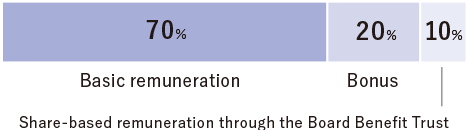
Composition ratio of remuneration
The ratios of basic remuneration (monetary), bonuses (performance-linked remuneration), and share-based remuneration through the Board Benefit Trust (non-monetary) for each individual is based on the standard shown on the right, giving consideration to the degree of contribution to business performance of each position, the status of management, social trends, and remuneration levels at companies of a similar scale to the Company belonging to related industries or having related business models.
Cross-shareholdings
The Company classifies stocks held for the purpose of receiving profits from fluctuations in stock values or dividends as stocks held for purely investment purposes and other stocks as stocks held for purposes other than purely investment purposes.
The Company acquires and holds shares in business partners when it determines that such holdings will contribute to increasing the Company’s corporate value over the medium- to long-term from the perspective of building and strengthening relationships with those business partners and forming business alliances.
In addition, the Board of Directors examines individual cross-shareholdings each year in terms of the purpose of holding, transactional status and dividends, among other factors, and makes a comprehensive decision on whether to hold or reduce these shares.
Investment shares held for purposes other than purely investment purposes
| Classification | Number of stocks and amount on balance sheet | Stocks with an increase in the number of shares in FY2025 | Stocks with a decrease in the number of shares in FY2025 | Reasons for increase/decrease |
|---|---|---|---|---|
| Listed stocks | 17 stocks/9,838 million yen | - | 1 stock/4 million yen | Decrease: decision based on economic rationality |
| Unlisted stocks | 7 stocks/14 million yen | - | - | - |
Standards for exercising the voting rights of cross-shareholdings
The Company votes for or against a proposal after making a comprehensive judgment on whether it will contribute to increasing its corporate value and the medium- to long-term interests of its shareholders, investors, and other stakeholders.
Round-table Discussion of Chairperson of the Board of Directors and Outside Directors
Further improving the quality of discussions and focusing on the creation of new businesses
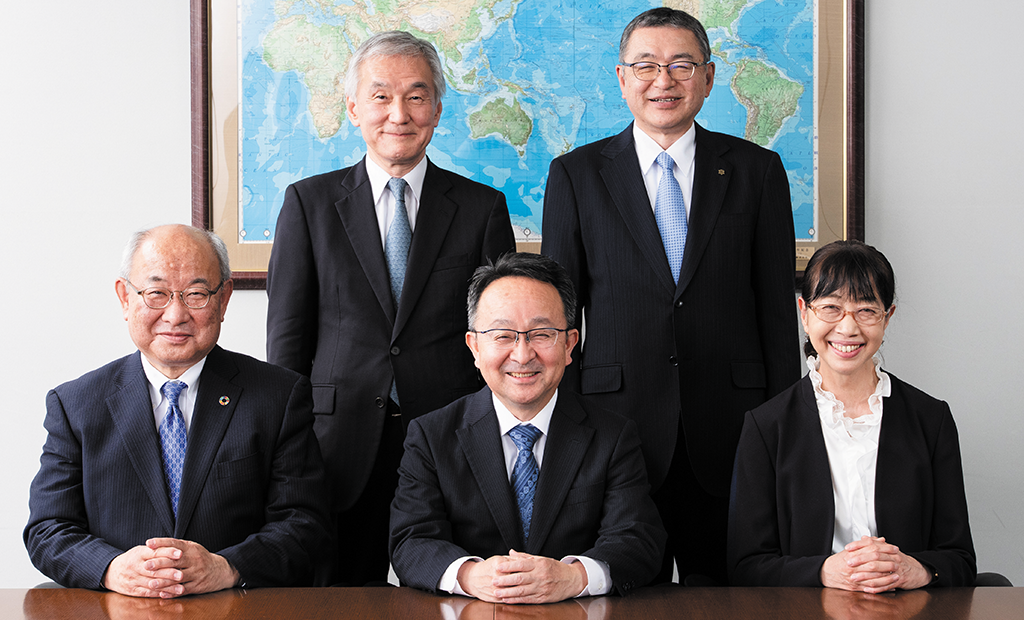
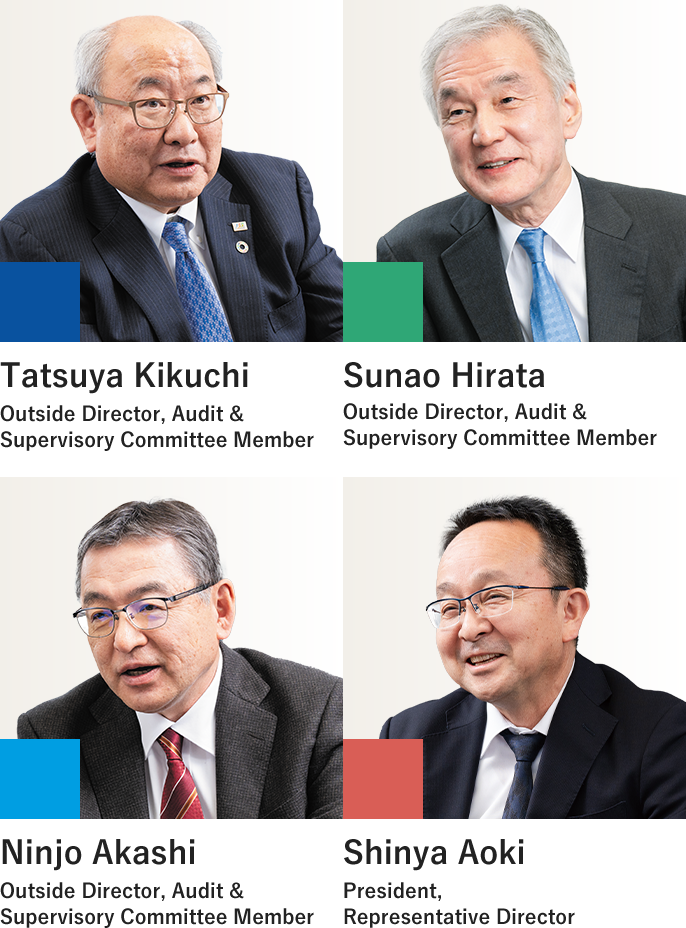
Two years have passed since President Aoki took over, and he now serves as Chairperson of the Board of Directors, which is effectively fulfilling its auditing function. In this roundtable discussion, four Outside Directors and President Aoki sat down to discuss measures to further improve the effectiveness of the Board of Directors and increase corporate value.
Outside Director,
Audit & Supervisory Committee Member
Tatsuya Kikuchi
Outside Director,
Audit & Supervisory Committee Member
Sunao Hirata
President,
Representative Director
Chairperson of the Board
of Directors
Shinya Aoki
Outside Director,
Audit & Supervisory Committee Member
Ninjo Akashi
Outside Director,
Audit & Supervisory Committee Member
Yumiko Yoshie
- * This roundtable discussion took place on March 27, 2026
- * Sunao Hirata and Ninjo Akashi, who served as Outside Directors, retired on June 26, 2026.
■ Hirata
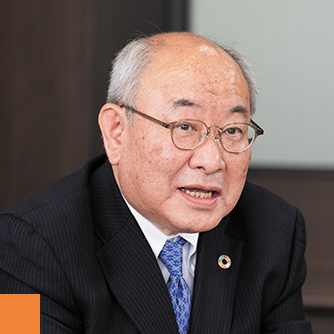
I believe that the Board of Directors has undergone a significant transformation since President Aoki took over as chairperson in June 2024. Specifically, ahead of deliberations, President Aoki now clearly outlines the background information and key points of discussion for each agenda item. This is an extremely effective method for improving the quality of discussions. These explanations are highly accurate and based on a deep understanding of the situation on the ground. For the past two years, the president has been actively visiting workplaces across the country and conducting town hall-style meetings to gain a better understanding of frontline operations. The experience he has accumulated is evident in every word.
■ Kikuchi
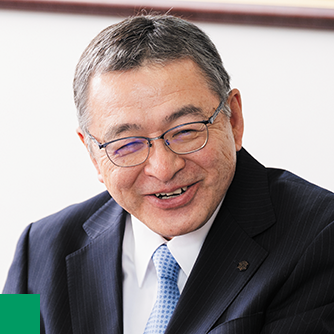
The quality of deliberations at Board of Directors meetings has always been high and this has been consistently maintained since President Aoki became chairperson. One of the biggest changes I have noticed under Mr. Aoki is in the monthly business reports. From financial statements to inventory management, everything is now reported in extreme detail. Through these detailed explanations, I feel that the activities of the business execution side have become more transparent than ever before.
■ Akashi
Indeed, the operation of the Board of Directors is steadily improving. President Aoki has consistently focused on carefully listening to the opinions of each department and lowering the barriers between them. As a result, I feel that his insights into frontline operations have deepened, and his presentation of talking points to the Board of Directors has become more refined. As Mr. Kikuchi pointed out, monthly business reports have also become more comprehensive. Building on this, I believe we can further stimulate discussions by adding an analysis of the previous month’s challenges and a forecast for the current month based on those analyses.
■ Yoshie
Although my perspective differs from yours, I feel that the progress in digitalizing meeting materials has also helped to deepen discussions. With the digitalization of documents that were previously in paper format, keyword searches and other features have become available, allowing for more efficient and in-depth reading of these materials. The challenge going forward is to further improve the quality of the materials themselves. While there are no fundamental flaws in the operation of the Board of Directors meetings, the materials used as the basis for discussions often consist of mere lists of numbers, making it difficult to discern key points and identify the factors contributing to improvements in performance.
■ Akashi
Indeed, the materials themselves need to be refined in order to hold more in-depth discussions. Moreover, to stimulate discussion within the limited time available, I believe it is important to engage in more active discussions that delve into the nuances and unspoken meanings that cannot be fully conveyed in the meeting materials.
■ Aoki
Thank you for your insights. Since taking the reins as President, I have tried my best to approach matters, including the operation of the Board of Directors, from the baseline, without being bound by past practices. Former President Matsumoto, now an Executive Adviser, also respects this stance. Regarding understanding the situation on the ground, in addition to the town hall-style meetings you mentioned, I am also actively attending sales meetings for each business to gather information. As for the monthly reports, as you pointed out, improvements are needed to ensure they are more mindful of the PDCA cycle. However, I maintain my stance of respecting the reporter’s initiative while providing advice and feedback as needed, rather than simply adopting a top-down approach. We have been prioritizing speed in discussions at Board of Directors meetings, but we are still only halfway there. I always ask our Outside Directors for their opinions, constantly questioning whether there are any areas where Nichimo’s functions are inferior to those of other companies, or whether any course corrections are needed.
■ Kikuchi
The keywords of the medium-term management plan, “acceleration” and “paradigm shift,” have been adopted as slogans by President Aoki. Efforts are being made to ensure their thorough implementation at the operational level, but the reality is that they have not yet yielded sufficient results. To achieve acceleration, it is vital that the Company strengthen the creativity and initiative of each and every employee. Flexible thinking that is not bound by existing frameworks is the driving force behind swift action. Furthermore, while there are various aspects of paradigm shifts, I view this as a process of reviewing Nichimo’s current business portfolio, which is heavily reliant on the Food Business, and building a balanced and stable business structure by further developing the Marine, Machinery, and Materials Businesses. In the development of marine materials that help improve the environment, such as aquaculture and offshore wind power generation, there are areas where results may not be seen in a short period of time. In these domains, it is crucial to take a medium- to long-term perspective and steadily expand efforts.
■ Hirata
As you say, in order to achieve acceleration, Nichimo needs to challenge conventional thinking and methods. Nichimo has a wonderful corporate culture and deeply rooted traditional values, making it a comfortable workplace for its employees. From my own sales experience, I keenly feel how difficult it is to break away from long-standing traditions when interacting directly with customers. However, creating a culture that can overcome these obstacles requires strong top-down communication. As an Outside Director, I am aware that I should support that stance. Even in a paradigm shift, top management decisions are essential. Investment decisions regarding which sectors will generate growth, as well as the decision to withdraw from areas where growth is unlikely, ultimately require the president’s decisive judgment. I believe that these difficult decisions are now being made appropriately.
■ Akashi
Gathering information to make accurate decisions is crucial to making acceleration possible. Going forward, we need to further improve both the quantity and quality of information. Only the sales department is capable of collecting and consolidating this kind of information. Enhancing sales capabilities enables faster decision-making in all areas.
This is something I personally experienced having worked in trading companies for many years, and I believe that having a trading company mindset is crucial now more than ever. Furthermore, sharing and utilizing information held by each business division across Nichimo should lead to paradigm shifts and the creation of new businesses. Enthusiasm is also vital for acceleration. When I visit plants and subsidiaries, I can feel the passion of the employees. If that passion manifests itself in concrete form, the pace of change will naturally accelerate.
■ Yoshie
Responding to paradigm shifts in society is also an urgent task. Recently, the emergence of geopolitical risks has made it difficult to procure raw materials in the synthetic products sector. To respond to these rapid changes in society as a whole, it is essential to further accelerate management and business operations. As Mr. Hirata pointed out earlier, while Nichimo is a comfortable workplace for its employees, in order to accelerate a change in mindset within the Company, management should more proactively communicate the Company’s strengths and appeal to employees. If employees themselves can reaffirm the value of their own company, Nichimo will likely appear as an even more attractive workplace to job seekers.
■ Aoki
All of your comments have really resonated with me. As Mr. Kikuchi said, the paradigm shift in the Marine Business requires a long-term approach, and now is the time to move forward with patience. I was worried that our very ambitious vision for the future in aquaculture and environmental materials might actually be lowering employee motivation, but your encouragement has strengthened my resolve. From this long-term perspective, we will focus on value creation while also giving full consideration to securing short-term profits and returning them to shareholders. Regarding the creation of a workplace culture that generates paradigm shifts that Mr. Hirata and Ms. Yoshie pointed out, I agree completely, and we will put even more effort into top-down communication going forward. Furthermore, I myself have a deep understanding of the importance of cultivating the trading company mindset that Mr. Akashi mentioned. Having both manufacturing and trading company functions is a unique strength of Nichimo that other companies simply do not possess. We will aim to make the most of this uniqueness and use it to drive further growth.
■ Kikuchi
Regarding capital efficiency, from a business-by-business perspective, as I mentioned when discussing strengthening the business portfolio, it is necessary to build a system that expands the relatively high-profit margin of the Marine, Machinery, and Materials Businesses to complement the profit margin of the Food Business. If Nichimo can steadily move forward with this initiative, the Company’s reputation among institutional investors will improve organically. On the other hand, regarding risks, as Ms. Yoshie pointed out, it is necessary to take swift action in response to the emergence of geopolitical risks. For example, in the Food Business, the Company has many operations in regions susceptible to country risk, such as the United States, China, Russia, and Southeast Asia. While I am concerned about this, I believe that the Company’s frontline operations’ awareness of risk is very high, and they are able to control it appropriately.
■ Hirata
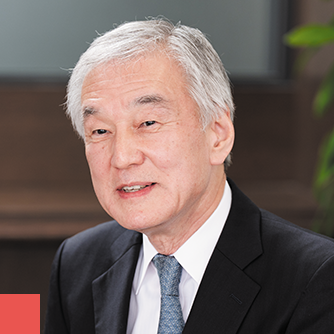
A PBR below 1 means that invested capital is not being used appropriately, or is perceived as such by the market. While the effective use of management resources ultimately rests with management, our role as Outside Directors is to constantly encourage them to put in the effort and use their ingenuity to maximize invested capital. The improvement of ROIC has been discussed repeatedly at Board of Directors meetings. While the widespread adoption of a capital efficiency-focused approach is still a work in progress, we Outside Directors are actively working to establish ROIC management. Regarding the risks associated with environmental changes, it is crucial to develop business plans while paying close attention to market assumptions.
Specifically, we advise management to always consider how deviations from normal environmental conditions will affect their plans when making management decisions. Environmental changes represent both risks and business opportunities. Nichimo should accurately identify variable risks, analyze their impact from multiple perspectives, and utilize that information in business management.
■ Akashi
If Nichimo becomes complacent with the perception that its current performance is strong, there is the risk of underestimating the potential for further growth. Each business likely still has potential for increasing profitability. The Food Business is facing intense competition and a tough environment in which companies are vying for a limited market share. On the other hand, while the Machinery Business has relatively high profit margins, some investors may not be satisfied with the current situation. Considering the potential for expansion into fields other than Food, and the possibility of adding high value through the use of AI and IoT, the Machinery Business still has great potential. Regarding risks, as Mr. Kikuchi pointed out, the Food Business is highly uncertain. However, the crisis management awareness among the personnel on the ground is very high, and I am confident that Nichimo can continue to generate profits by appropriately controlling the situation.
■ Yoshie
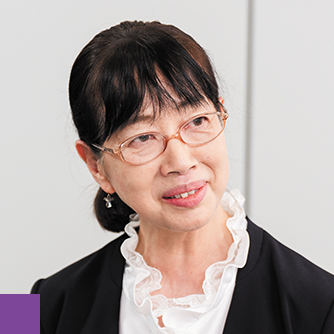
As Mr. Hirata pointed out, I feel that there are still challenges remaining in terms of whether the concepts of PBR and ROIC have been sufficiently disseminated to frontline operations. A detailed analysis of these indicators will clearly reveal areas where Nichimo is performing well and areas where there is room for improvement.
If the Company creates a system that allows employees on the ground to proactively conduct these analyses, Nichimo can expect to see improved PBR and ROIC driven by frontline personnel. As everyone has pointed out, there are risks in the Food Business, but I myself have visited several plants and confirmed that data management is thoroughly implemented on-site. I sincerely hope that these steady efforts will continue in the future.
■ Aoki
To improve ROIC, the key is to invest capital efficiently and obtain the maximum possible return. However, the concept of time frame is also important when considering the expected return. Optimizing the balance between investing capital to deepen existing businesses and making strategic investments with a view to future business expansion is a crucial management challenge. Furthermore, it is essential to consider not only economic value but also the creation of societal value. As well, I believe that a healthy organizational structure involves both top-down decision-making and bottom-up initiatives from the frontlines. As Mr. Hirata pointed out, risk and opportunity are two sides of the same coin.
Regarding geopolitical risks, current overseas operations are, in extreme terms, heavily skewed towards buying (procurement), creating a structure where risks tend to materialize easily. Going forward, it is crucial to steadily generate sales overseas and build a more multi-layered business model.
■ Kikuchi
Japan is one of the world’s leading maritime nations. People’s interest in the ocean is higher than ever before, driven by a rich food culture utilizing marine products, offshore wind power generation, and the value of rare earth elements found in the deep sea. Nichimo has gone through its founding period, which started with the manufacturing of fishing nets, and its second founding period, which involved expanding the Food Business. Today, it is entering its third founding period. To survive these turbulent times, Nichimo must enhance capital efficiency and complete a compelling growth story centered on its three core businesses: Food, Marine, and Machinery. As an Outside Director, I will do my utmost to support the fulfillment of this goal.
■ Hirata
There are two things I expect from Nichimo in the future. The first is the stable supply of fishery resources. Amid a decline in Japan’s fish catches, Nichimo bears a significant social responsibility to ensure a stable supply of resources both domestically and internationally, including through land-based aquaculture. We Outside Directors should always be deeply aware of this importance. The second point is human resources. In this rapidly changing era, securing and developing talent with diverse skills is essential, and I hope that the entire organization will focus on this.
■ Akashi
There are things that only Nichimo, with its long history in the Marine Business, can do, and things that only Nichimo can accomplish. The Company’s three main business pillars—Food, Marine, and Machinery—are domains where Nichimo can expect significant growth in the future. I hope that the Company will seize new business opportunities in these domains by leveraging its unique strengths. As an Outside Director, I will actively support the Company’s challenges and growth.
■ Yoshie
Considering the potential and room for effective utilization of the ocean, Nichimo is an important company that should succeed in the marine business and achieve sustainable growth. The Company’s strength lies not only in being a platform company that integrates diverse functions, but also in being a grounded manufacturing company with a history of over 100 years. I hope that investors and other stakeholders will gain a deeper understanding of these essential values of Nichimo.
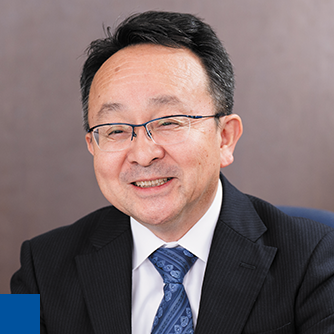
■ Aoki
During today’s discussion, there were many instances where my own thoughts were mirrored, which strengthened my resolve.
As you pointed out, securing and developing talent is one of the most important factors determining our future, and our belief that “human resources are our greatest investment in growth” remains unshaken. I believe that the driving force behind creating new businesses also comes from the networking and shift in thinking of each and every employee.
Thanks to all of you, we were able to have an extremely meaningful discussion. I will steadily incorporate the valuable suggestions received today into our business operations.

Internal Control
Basic views
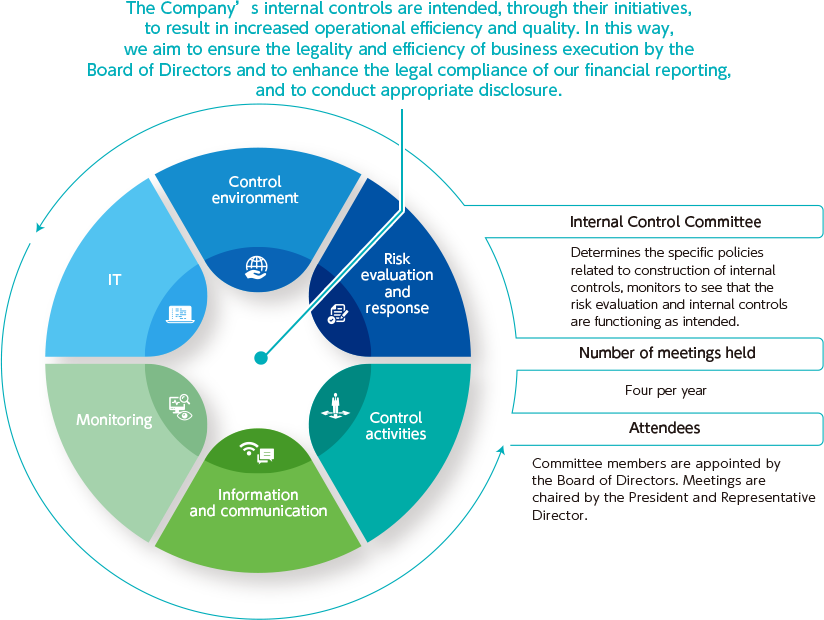
The Company’s internal controls are intended, through their initiatives, to result in increased operational efficiency and quality. In this way, we aim to ensure the legality and efficiency of business execution by the Board of Directors and to enhance the legal compliance of our financial reporting, and to conduct appropriate disclosure. Furthermore, to achieve the objectives of our internal controls, we have arranged our business processes to incorporate responses to six basic elements: “control environment,” “risk evaluation and response,” “control activities,” “information and communication,” “monitoring,” and “IT”; and we have established structures for ensuring that these business processes are reliably executed.
Internal control activities in FY2025
With the aim of making medium- to long-term improvements to our anti-corruption system, we reviewed our whistleblowing system in FY2024 and established a new external contact point. Prior to the launch, we held briefings for employees to inform them about the establishment of the external contact point and the reporting procedures, as well as to explain the Whistleblower Protection Act. In FY2025, we worked to promote the use of our whistleblowing system by conducting internal training for the Group’s management, which included the introduction of past whistleblowing cases.
With regard to important laws and regulations, we remain committed to complying with the Act on Preventing Delay in Payment to Small and Medium-Sized Entrusted Business Operators in Relation to Manufacturing Consignment. We have been making preparations to facilitate compliance with the revisions to the Act against Delay in Payment of Subcontract Proceeds, etc. to Subcontractors that took effect in January 2026, by disseminating information to relevant personnel within the Group as soon as it becomes available and arranging e-learning courses for managers and staff responsible for implementing these changes in their daily work. We plan to continue treating regulatory compliance as a key issue for the Group in FY2026 onward.
Progress in addressing material issues in internal control
| Materiality | Main KPIs | Targets | Actual results for FY2025 | |
|---|---|---|---|---|
| Target value | Target achievement year | |||
| Anti-corruption system | Implementing medium- and long-term improvements to the anti-corruption system → Implement educational activities aimed at promoting the use of the whistleblowing system (e.g., sharing examples from other companies) | - | 2025 | Conducted internal training for the presidents of Nichimo and Group companies. |
| Internal control and legal compliance status inspections | Number of incidents of serious fraud and misconduct →Response to fraud and misconduct through whistleblowing, audits, etc. | 0 | 2025 | 0 |
| Compliance with important laws and regulations such as the Act on Preventing Delay in Payment to Small and Medium-Sized Entrusted Business Operators in Relation to Manufacturing Consignment | • Conducting training on important laws and regulations • Providing support to Group companies regarding compliance with the Act on Preventing Delay in Payment to Small and Medium-Sized Entrusted Business Operators in Relation to Manufacturing Consignment and other relevant laws | Once/year or more | 2025 | • Conducted training on compliance with relevant laws and regulations, as well as e-learning training on the Act on Preventing Delay in Payment to Small and Medium-Sized Entrusted Business Operators in Relation to Manufacturing Consignment, to provide employees with input on important laws and regulations and to foster an awareness of legal compliance • Provided support to Group companies regarding compliance with the Act on Preventing Delay in Payment to Small and Medium-Sized Entrusted Business Operators in Relation to Manufacturing Consignment and other relevant laws |
| Whistleblowing system | Appropriate operation of the whistleblowing system → Awareness of the whistleblowing system and how to respond when a report is received. | - | 2025 | 14 reports |
Administrative meeting held to strengthen internal controls across the entire Group
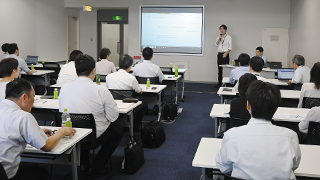
The Group implemented an administrative meeting with the participation of administrative personnel from each Group company. The goal was to strengthen internal controls and improve management functions throughout the Group. At the meeting, participants shared challenges and case studies related to legal compliance, risk management, and financial and labor management, and exchanged opinions on practical challenges faced by each company. By improving management standards while maintaining a shared understanding among all Group companies, we are enhancing the effectiveness of internal controls and strengthening governance across the entire Group.
The gathering of administrative personnel of the Group companies served as a valuable opportunity not only to strengthen inter-company collaboration but also to provide a platform for interaction among employees who do not usually have much contact in their daily work. Building relationships based on mutual understanding and trust leads to an environment where information sharing and consultation are easier. This is expected to lead to quicker collaboration should a contingency occur. The Group will continue to implement these initiatives and strive to strengthen the management foundation underpinning sustainable growth.
Compliance
Basic views
The Group shall thoroughly comply with business ethics and social norms, such as legal compliance and matters prescribed in the “Nichimo Group’s Charter of Corporate Behavior,” and promote its “Compliance Program” in order to undertake its social mission as a company.
Compliance system
The Company has prescribed the “Nichimo Group’s Charter of Corporate Behavior” and the “Compliance Regulations,” which are based on the Company’s corporate philosophy, as the basis of the compliance system, distributes and raises awareness about them to the employees of all Group companies, and thoroughly carries them out throughout the Group, with the Board of Directors taking the initiative. Furthermore, the Company established the Compliance Committee chaired by the President and Representative Director, and operates it as an organization that maintains and promotes the “Compliance Program.”
Whistleblowing system
After establishing the “Whistleblowing System Regulations” in order to protect whistleblowers, the Company operates the whistleblowing system, with the officer in charge of compliance as the responsible person, as a system to promptly recognize organizational or individual fraud, illegal activities or unethical actions, and minimize and solve at an early stage the Company’s crisis from illegal activities, etc. In FY2024, we introduced an external reporting system within the Group and began operating it in conjunction with measures to promote awareness of the system. The aim is to improve the effectiveness of our systems in response to amendments to related laws and regulations, such as the enforcement of the amended Whistleblower Protection Act, and heightened awareness of compliance in society.
Risk Management
Basic views
The Group stipulates the Crisis Management Guidelines, establishes basic countermeasures for crises and risks related to corporate management, and minimizes and solves at an early stage the risks that arise. Having established the Regulations for Risk Countermeasures for the response in the event that problems occur, the Company will swiftly respond and establish a system that prevents the increase of losses in the event that unforeseen circumstances occur.
Business continuity plan (BCP)
The Company distributes and raises awareness about the BCP manual to all employees in the event of a disaster, and has established a system that allows confirmation and response at any time. Furthermore, in the event of the spread of various infectious diseases or disasters, such as earthquakes, the Company establishes the Countermeasure Division, and ensures the safety of employees and carries out the response for business continuity in line with the manual.
Initiatives for food safety
With regard to food production, in addition to taking a leading role in ensuring that the Company responsibly provides products, the Food Quality Management Department establishes and thoroughly maintains and manages the quality control system, and carries out inspections at all the Group and partner plants in Japan and overseas. If the manufacturing lines of plants, management of employees, various bookkeeping, etc. do not satisfy the standards required by the Company, the Company will not be able to produce its products. As problems, such as contamination by foreign materials, will cause significant damage to business, the Company will identify the cause, apply an immediate remedy, and continue to thoroughly control quality and train employees.
Managing supply chain risks
The Group is presently exposed to various supply chain risks in its business domains. Geopolitical risks as well as drastic fluctuations in foreign exchange rates are causing procurement difficulties and high prices for raw materials and energy. The Company has taken response measures, such as using a variety of purchasing channels, diversifying its procurement regions and implementing appropriate inventory management in response to risk. The Company also audits and revises the Group’s risk management system as needed.
Management of information security and system operations
The Group has established the Information Security Management Regulations and has prepared the information security systems necessary for safe and rational operation of information systems and protection of information assets such as personal information and company secrets.
We define information security as protecting information assets from threats and keeping them in a state where they can be managed appropriately and used with confidence, working to guarantee their “confidentiality,” “completeness,” and “availability.”
Furthermore, to ensure appropriate operation of the Group’s information systems, we have established the Information System Operation Committee, which is chaired by the Director in charge of the administrative section, and we have adopted a structure for appropriately revising, maintaining, and promoting regulations, organizations, and management structure, and so forth, related to information systems.
Initiatives for the climate change risks
As one of the specific initiatives for promoting sustainability management, the Group recognized the issue of climate change as a key management issue, and declared its agreement with the recommendations of the Task Force for Climate-related Financial Disclosures (TCFD) in April 2023. In addition, following the framework proposed by the TCFD, at the Sustainability Promotion Committee under the supervision of the Board of Directors, the Company is assessing the level of impact of the risks and opportunities that will be brought to the Group’s businesses by climate change in the future using the scenario analysis method. Please see here for details of the Company’s response to climate change (information disclosure based on the TCFD recommendations).