Dialogue Nichimo Group’s Financial Strategy
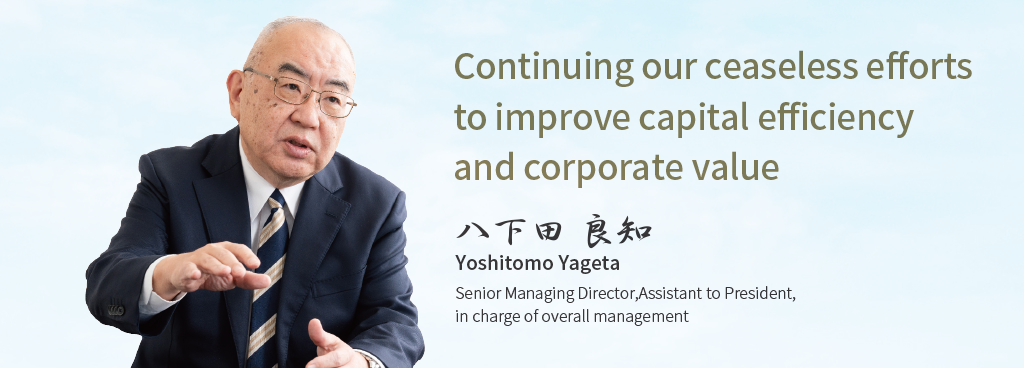
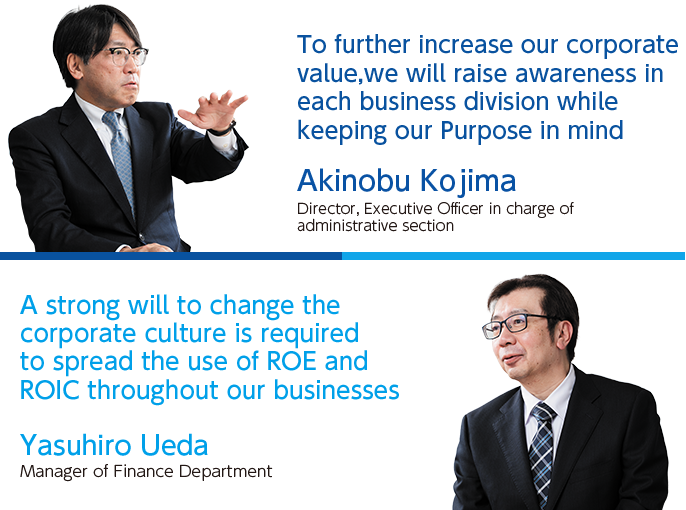
—How do you evaluate the strengths of the Nichimo Group’s business model and its earning power from a financial perspective?
■ Kojima
Nichimo may appear to be a trading company at first glance, but its roots lie in the manufacturing of fishing nets and fishing gear. This commitment to “making” things—which is the DNA of a manufacturer—is our fundamental strength. For example, in our Food Business, we do more than simply purchase marine products from overseas; we also send technicians to the locations where it is sourced. To ensure the products meet the quality and standards demanded by the Japanese market, they provide direct guidance on-site and are involved in the product manufacturing process. This represents a manufacturer-like approach that goes beyond a typical trading company.
The same principle applies to our rapidly growing Machinery Business as well. How can we combine the food processing machinery manufactured by numerous small- and medium-sized specialized manufacturers to create the optimal production line in our customers’ plants? We are responsible for that engineering. This requires in-depth knowledge of each individual machine and cannot be accomplished by simply moving things “from right to left.” Each business is deeply rooted in its field and possesses an in-depth understanding of the everyday aspects of manufacturing. That history and amassed know-how are the sources of Nichimo’s unique added value.
■ Ueda
From a financial perspective, Nichimo is characterized by the discretion given to individual sales representatives who can handle large transaction values. In our Food Business, we sometimes make purchases on the scale of 3.0 million US dollars per lot, and in our Machinery Business, we have seen deals exceeding 1.0 billion yen per production line. Each individual plays a significant role in driving large-scale businesses. Of course, we recognize that this is only possible because of the foundation of know-how and information that Nichimo has cultivated over many years.
―Can you discuss Nichimo’s performance in FY2025 as well as the achievements and challenges from the first year of the Fiscal 2026 Medium-Term Management Plan (Breaking Through Toward 2028)?
■ Kojima
In FY2025, we faced the harsh realities of the domestic market. Amid a shift in the macroeconomic environment from deflation to inflation, price revisions failed to fully resonate with consumers, particularly in the second half of the year, resulting in sluggish sales volume growth. Poor catches of major fishery resources, such as Chum salmon and scallops, were also headwinds for the business environment. Our current medium-term management plan was formulated using a backcasting approach. We have redefined each business into domains such as “growth” and “profitability improvement,” and the first year is truly the initial stage of getting things moving. There are many new initiatives, and to use a car analogy, it is as if we have just shifted into low gear. Building on the positive feedback gained over the past year, we will steadily shift gears up and accelerate our growth. I view this as an important challenge that we now face.
■ Ueda
A major achievement in terms of finances is that we have taken a definitive step toward stabilizing and diversifying our fundraising. Backed by stable performance in recent years, our financial structure has been strengthened, creating a foundation that can financially support new challenges in our Food Business. Furthermore, we have begun concrete preparations to obtain external credit ratings, something we have not been able to do until now. While we have primarily relied on long-term fixed-rate financing to date, amid the changing interest rate environment in Japan, we will also consider issuing commercial paper and other options to optimize short-term financing costs. We are confident that expanding our fundraising options will directly contribute to the stability of the Group’s overall financial foundation, and ultimately lead to greater management flexibility.
—To remedy your PBR being below 1, how will you instill management conscious of capital efficiency, such as by introducing Return on Invested Capital (ROIC) as a metric?
■ Ueda
When we calculated ROIC for each business segment, it revealed their individual characteristics. The structure of invested capital is fundamentally different between the Food Business, which has large inventories, and the Machinery Business, where human capital is the source of value. Accordingly, the ROIC figure calculated also differs significantly. Going forward, one key to management will be how each department utilizes these figures in a way that suits its specific business characteristics, thereby improving capital efficiency.
■ Kojima
Our introduction of business-specific ROIC has only just reached the starting line. After reaching an internal consensus on how to allocate interest-bearing debt and net assets to each business, we have finally begun the full-scale adoption of ROIC into each business division. Incorporating the quantitative metric of ROIC as a common denominator of decision-making processes that tend to rely on qualitative judgments will unlock more objective discussions.
In the future, we want to foster a culture where each individual is strongly aware of the cost of capital by linking inventory turnover and other KPIs derived from ROIC to the evaluation system for individual employees. During decision-making regarding M&A and business divestitures, we will position ROIC as a crucial compass and steadily implement disciplined transformation of our business portfolio.
■ Ueda
Until now, everyone has focused on the profit shown on the income statement (P/L), and there has been insufficient awareness of the balance sheet (B/S). Introducing ROIC encourages a shift towards management that is conscious of invested capital, or in other words, the balance sheet. How can we generate profits efficiently while being mindful of costs such as the capital entrusted to us by our shareholders and borrowings from financial institutions? We believe it is essential to share and instill this awareness throughout the Company.
—What are your thoughts on the balance between growth investments and shareholder returns, and the role of the Finance Department in the future?
■ Kojima
Enhancing shareholder returns is an important task of management. We will steadily commit to achieving the payout ratio of 35% or higher, which was set in our medium-term management plan. On the other hand, agile growth investments are essential for companies to achieve sustainable growth. Our current challenge is generating the free cash flow to fund these investments. Steadily generate profits, earn cash, and optimally allocate it to growth investments and shareholder returns— establishing and solidifying this value creation cycle is paramount to sustainable improvement of corporate value.
■ Ueda
We need to deeply instill the concept of cash flow, along with ROIC, internally. How does the cash generated by each business division contribute to growth investments and shareholder returns for the entire Group? I want to create a system where everyone can intuitively understand the answer to this question.
As part of this foundation, we are proceeding with a complete overhaul of the Group’s core systems, aiming for the systems to be operational in April 2028. By extensively standardizing and streamlining business processes, we will create an environment where each person in charge on the ground can quickly and accurately understand management figures and utilize them in daily decision-making.
■ Kojima
The challenges outlined in our Purpose must never be chosen recklessly. The mission of the administrative section is to support and, at times, regulate these challenges that are backed by meticulous planning and evidence. Nichimo is a company comprised of individuals with exceptional strengths. The question is how we combine those individual strengths to compete as an organization. We will shore up the discipline and systems necessary for this, and work together as a Group to create new value for the future.
Nichimo’s Management
Launch of ROIC management ―Taking on the challenge of sustainable corporate value improvement―
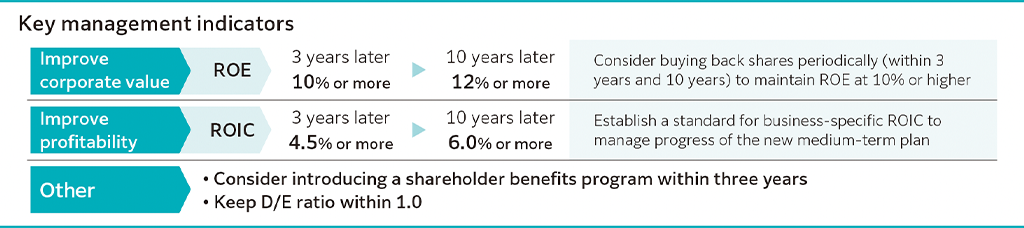
In our Fiscal 2026 Medium-Term Management Plan, we have set “Strengthen core businesses and stabilize earnings structure” as our basic policy, and we are promoting a business portfolio transformation aimed at sustainable profit growth. Based on this policy, we have newly designated return on invested capital, or ROIC, as an important management indicator. ROIC is an indicator that shows how efficiently profits are being generated relative to the capital invested in a business and it measures whether invested funds are being recovered appropriately. We intend to use ROIC as an important decision-making factor in future investment decisions. Through management of each business segment on a consolidated basis, we aim to promote performance management conscious of capital efficiency and the selection and concentration of businesses, thereby building a balanced earnings structure.

Characteristics and challenges revealed by the calculations
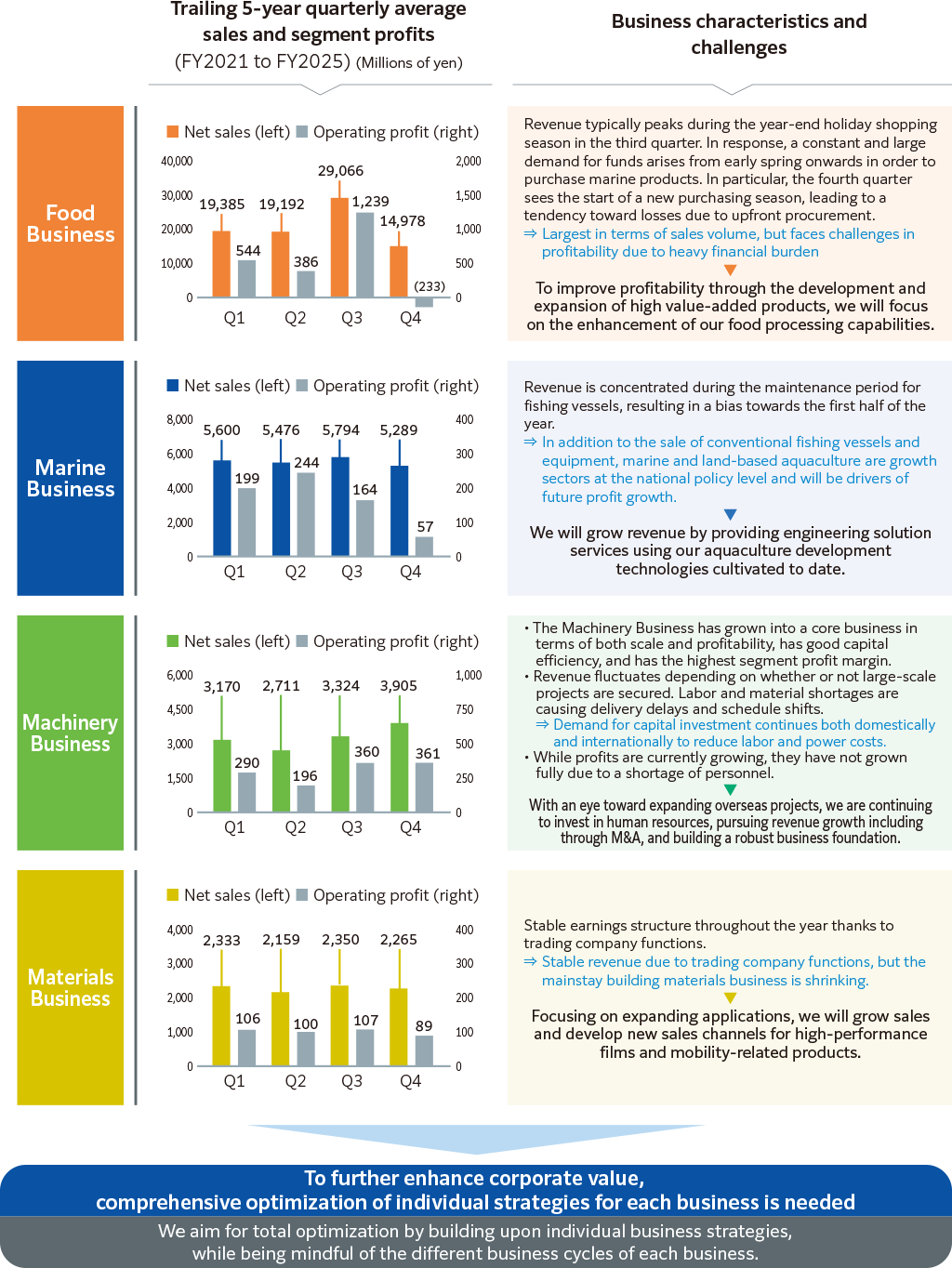
Looking at the Nichimo Group as a whole, invested capital tends to be correlated with net sales. Therefore, we recognize that improving profitability, specifically the operating profit margin, is crucial, in addition to improving the capital turnover ratio, in order to increase ROIC. Invested capital’s tendency to be correlated with net sales is particularly remarkable in the food segment, which is Nichimo’s largest segment, and as it is difficult to significantly improve the net sales/invested capital turnover ratio given its business structure, the main driver of ROIC improvement is the operating profit margin. Specifically, we believe that improving profit margins through the development and expansion of high-value-added products, eliminating unprofitable products, and improving productivity will directly increase ROIC.
The Marine Business has a higher proportion of fixed assets compared to our other business segments. Therefore, the key to improving capital efficiency will be how efficiently we can generate operating profit using these assets. In our Machinery Business, when dealing with large-scale food manufacturing machinery, we generally take measures to mitigate risk by dividing customers’ payments into several stages, such as at the time of contract signing, delivery, and inspection, resulting in a financially efficient business structure. The Materials Business, with its strong trading company functions, offers stable revenue and higher capital efficiency than the Food and Marine Businesses.
Furthermore, the ROIC of the four major businesses exceeded the business-specific WACC (weighted average cost of capital/hurdle rate), confirming that each business is generating profits that are above the minimum required for the invested capital. Going forward, we will continue to strive for capital efficiency in our management across our entire portfolio of major businesses.
As for future initiatives, in addition to regular monitoring, we are considering subdividing the ROIC calculation units by team.
Company-wide cash conversion cycle (CCC)
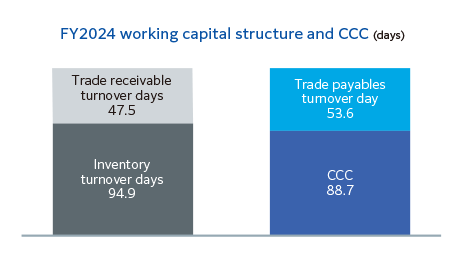
- *CCC: A financial indicator that shows the period (number of days) from payment for goods to collection of sales proceeds. The shorter the period, the higher the capital efficiency.
The cash conversion cycle (CCC) is an important management indicator for measuring working capital efficiency that shows how long cash is tied up, from procurement to sales and collection. Our CCC is 88.7 days, but our trade receivable collection period and accounts payable payment period are generally in balance. A characteristic of the Food Business is that the fishing season for marine products is concentrated from early spring to early autumn, so purchases are made in advance of sales, leading to an increase in inventories and a major factor pushing up CCC. CCC is closely related to the invested capital turnover ratio; if the CCC is prolonged, working capital increases, leading to a decrease in the invested capital turnover ratio. Therefore, in order to increase ROIC, we will continue to work on improving capital efficiency through the review of appropriate inventory levels and improvement of inventory turnover, in addition to increasing profitability.
Overview of Nichimo’s four major businesses