
Special Dialogue:Vibrant Ocean, Happy Dining —
Special Dialogue: Vibrant Ocean, Happy Dining —
A compass for Nichimo’s growth
Pioneering the development and sustainability of the marine products industry by combining academic knowledge (theory) with frontline capabilities (practice)
Nichimo aims to develop sustainable businesses based on scientific evidence and transform the changing operating environment into a growth opportunity. How can we combine the knowledge of industry and academia to strengthen Japan’s marine products industry? Tadashi Tokai, Professor Emeritus at Tokyo University of Marine Science and Technology and former President of the Japanese Society of Fisheries Science, and Shinya Aoki, Nichimo President, sat down to answer this question and discuss the future.
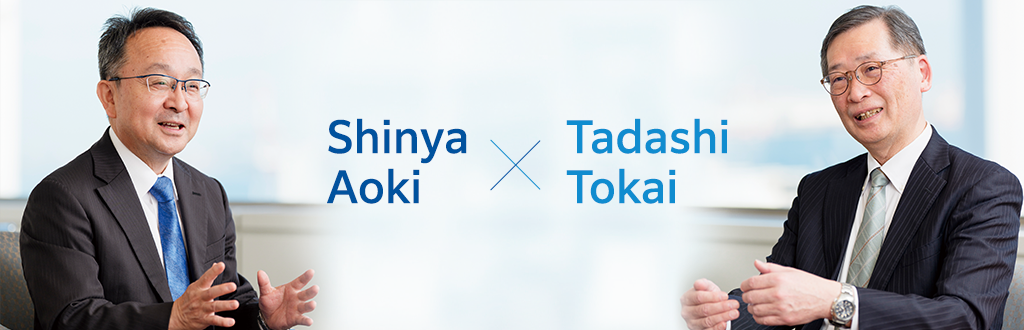
Product development based on scientific evidence will resolve the challenges of labor shortages and resource management in the marine products industry.
■ Tokai
Thank you for inviting me to today’s discussion. First, allow me to talk about the current situation in the marine products industry. Through the marine products industry, we play an extremely important role in delivering food resources from the sea to people, based on the blessing of sunlight. Fishing and aquaculture have always depended on a healthy global environment. In modern times, as we live in the Anthropocene, humanity now has such an influence that it can cause environmental changes on a global scale. In addition to climate change, the pursuit of sustainability has become a top priority in the fishing and aquaculture industries, as technological advancements can also place a burden on fishery resources and the marine environment.
On the other hand, domestically, the fishing industry faces serious challenges such as a decline in the working population and an aging workforce. Visiting ports in various regions, one can even see frustrating situations where, despite abundant fishery resources, the lack of workers prevents the fish from being harvested. How can we efficiently and sustainably enjoy the bounty of the sea with a limited workforce? This is also an urgent issue.
Academic researchers can build theories and develop technologies, but when it comes to the social implementation stage, where these technologies are put into practical use, the power of the private sector is indispensable. We alone cannot fully grasp all the detailed issues on the ground, and there is a risk that our ideas gleaned from research will end up being nothing more than theoretical speculation. That is why we seek feedback from companies with deep knowledge of the field and work together to create new value. Such two-way collaboration between industry and academia is what is essential.
In that respect, Nichimo handles everything from raw material procurement to delivery to consumers—From Ocean To Dining. The marine products industry has a broad base and many related industries, but currently these industries are fragmented. Even if individual parts excel, these industries cannot yield true power unless they are organically connected. I have high expectations that Nichimo’s integrated system will play a crucial role as a command center, connecting the diverse wisdom and strengths of the marine products industry and leading it toward solutions.
Furthermore, the fact that Nichimo engages in dialogue with those involved in local fishing industries and contributes to community upkeep and regional revitalization is very encouraging from an academic perspective. The sustainability of the marine products industry requires not only the preservation of the marine environment but also the fulfillment of a social responsibility to protect the lives and safety of the people who work in it.
■ Aoki
Thank you for your time today. I, too, feel that there are limits to what one company can accomplish on its own. Even though we refer to it collectively as the marine products industry, the field is extremely diverse, and the challenges faced on the ground vary greatly. To resolve these issues, I believe that collaboration with like-minded companies, universities, and research institutions is essential.
In particular, our collaboration with the Japanese Society of Fisheries Science is beginning to bear concrete results. Our engineers present their research findings at academic conferences, and these results are widely disseminated to relevant government ministries and agencies in their technological development programs, creating an ideal integration of practical application and academic research.
For example, to combat marine plastic pollution, which Professor Tokai is also researching, the Company was the first in the world to develop a biodegradable gillnet. This is a groundbreaking product that minimizes the impact on ecosystems caused by ghost fishing* even if left in the ocean, as it eventually decomposes and returns to nature. Furthermore, aquaculture nets made from biomass materials have been developed by combining the needs of those on the frontline who wanted to reduce their environmental impacts with the knowledge of academic societies. We are confident that product development based on such scientific evidence is our strength and a significant outcome of industry-academia collaboration.
Furthermore, we are currently working on a closed-loop recirculating land-based aquaculture system (RAS). We initially imported materials from Europe, but we encountered many issues in terms of logistics, standards, and maintenance, resulting in problems such as delays in material procurement and inconsistencies with domestic standards. Therefore, we are currently working with companies in Japan with leading technologies to promote the in-house production of equipment. Ultimately, we aim to bring together domestic technologies in the form of a consortium and widely disseminate land-based aquaculture facilities made in Japan.
What can be done in the broad field of the marine products industry? This is a wide-ranging domain, and ultimately, the key lies not only in inter-company collaboration but also in connections with like-minded people. We will continue to promote our business towards the realization of a sustainable marine products industry while valuing the trust we have built with our partners.
- * Ghost fishing: A phenomenon in which lost or abandoned fishing gear continues to catch fishery resources.
We will turn environmental regulations into a tailwind and set the global standard with innovative products such as biomass materials.
■ Tokai
Many people tend to view marine plastic pollution as something that does not concern them. In reality, though, most marine plastic waste originates from plastic products used in daily life, such as shopping bags and PET bottles, so it is closely connected to our lives. Furthermore, fishing gear and other fishing materials are also deeply related to the issue. These environmental issues have traditionally been treated as external diseconomies (costs) of economic activity. In recent years, however, with the advancement of ecosystem service assessments, ESG investment, and carbon pricing, there has been a growing movement to assess and reflect their value within the market. In other words, initiatives to conserve the environment itself directly lead to new business opportunities and value creation.
In addition to the environment, ensuring food safety and security is also crucial. By increasing transparency in the supply chain and extensively implementing traceability, we deliver marine products that consumers can trust. In building that foundation, there are extremely high societal expectations for Nichimo’s technological capabilities.
Nichimo is not only seriously addressing environmental issues in each of its business divisions, but is also integrating these efforts into a company-wide strategy and striving to create total value. I feel that this is really the ideal approach. During the country’s “lost 30 years,” many Japanese companies became accustomed to avoiding change. However, in today’s rapidly changing world, refusing to change means being left behind. The attitude of challenging and transforming oneself, which Nichimo has embodied, may very well be the catalyst that involves the entire Japanese marine products industry and leads to its revitalization.
■ Aoki
We, too, view change as a turning point toward sustainable growth. We believe that societal demands such as stricter environmental regulations and resource conservation are not headwinds, but rather tailwinds that create new demand.
For example, in the development of fishing gear using plant-based plastics (biomass plastics), we are seeing great promise, although cost challenges remain. While the scientific evidence is still being built, unexpected added value has been discovered. This includes octopus pots that catch more octopus than conventional petroleum-based ones and aquaculture nets that speed up the growth of mozuku.
Our goal is to elevate environmentally conscious products from mere high-cost alternatives to brands with high societal value, and to gain consumer recognition for that value. If we can create this kind of positive cycle, we should be able to change the way Japan’s fisheries market works. I believe it is extremely important to have these kinds of strategic cards in place when looking to the future. In addition, we are also focusing on building a supply chain that ensures food safety and security. By extensively implementing traceability, we will make the value of environmentally conscious marine products visible and ensure fair trade that respects human rights. We are confident that strengthening these governance structures will lead to greater trust from our customers and investors.
Nichimo will deliver precise management and labor-saving solutions packaged together. The technology supporting the workplace will foster job satisfaction and advancements.
■ Tokai
There are various ways to interpret the term “smart fisheries.” Many people probably imagine cutting-edge technologies such as resource management and environmental monitoring. However, I believe that the greatest potential of digitalization lies in areas that are much closer to home. For example, if ships had access to the Internet at sea just as we do on land, the working conditions of seafarers would improve dramatically. Digitalization would make it possible to receive real-time health consultations if a crewmember became ill on board, and to optimize the recruitment and management of short-term workers in response to the serious labor shortage.
In fact, the marine products industry has much more room for digitalization compared to other industries. While elemental technologies that resolve individual issues are emerging, we have yet to organically connect them and make them function as an integrated system for the entire marine products industry. Land-based aquaculture is a prime example. Researchers can create individual components such as water quality management, automated feeding, and monitoring of fish health, but it is difficult for a single researcher to integrate these diverse elemental technologies and build them into a single commercial system. In order to assemble these into a business package, it is absolutely essential that companies with deep knowledge of the field connect each component and elevate them into a sustainable business model.
■ Aoki
Labor and power saving is an important theme that Nichimo has been working on for many years. In the past, when introducing new machinery, we often received negative feedback from frontline staff, who would say, “It’s faster if we do it ourselves.” Yet, as generational change progresses, I feel that a foundation for flexibly accepting cutting-edge technologies is steadily being fostered. Recently, devices that use an electric shock to sedate fish to prevent them from struggling and allowing for them to be quickly and gently killed to preserve their freshness have been lauded for both reducing the burden of shipping operations and improving quality. Furthermore, technology-driven labor savings directly contribute to improvements in industrial safety and health. By automating and mechanizing demanding tasks, we reduce the risk of accidents and create a workplace environment where everyone can work in good health. We believe that management that respects these human resources represents the source of the next wave of innovation.
There is much we can learn from advanced fishing nations like Norway. Based on the premise of a limited population, they have long promoted extensive labor-saving and rationalization. For example, Norwegian feeding boats have been computer-controlled for over 20 years, creating a system where one person can manage dozens of fish cages. We should not be bound by traditional Japanese methods, but rather actively incorporate excellent, advanced practices and integrate them with our own technology.
Disseminating Japan’s unique solutions to the world. Nichimo aims to become a hub for industry-government-academia collaboration and create sustainable corporate value.
■ Tokai
I used to think 2030 was the distant future, but now it’s just around the corner. Amid the rapidly changing marine environment and international affairs, Japan’s marine products industry is also being forced to undergo transformation. Japanese fisheries research was once highly regarded, attracting many international students from around the world. In recent years, though, its presence has been fading into obscurity.
Now is the time to tackle challenges with a unique approach based on the knowledge and expertise that Japan has cultivated, rather than simply following in the footsteps of the rest of the world. We should present this entire process—research, technological development, and social implementation—to the world as a single “solution model.” Toward this end, collaboration between industry, government, and academia will be more important than ever. I have high expectations that Nichimo, with its deep understanding of fisheries and its own research and development capabilities, will become a hub for this collaboration and a powerful driving force in transforming the industry.
■ Aoki
Our current medium-term management plan was formulated using the backcasting method, which involves working backward from our ideal state 10 years from now. This is also a message to each and every employee, saying, “It is you, working on the front lines today, who will create the future 10 years from now.” I hope that each employee will reflect on what they want to be like in 10 years and then find what they need to do now to achieve that. As President, it is my responsibility to create a highly engaged workplace where employees, who will be the main players 10 years from now, can work with pride. Furthermore, I believe that continuing to promote the appeal of the marine products industry through food education activities for the next generation of children is an extremely important investment in the future.
Responding promptly to environmental challenges and maintaining strong collaboration with all stakeholders will undoubtedly remain key themes for shaping the future. To pass on a rich ocean and a thriving marine products industry to future generations, Nichimo will continue to take on new challenges.
■ Aoki
Industry-academia collaboration, including with the Japanese Society of Fisheries Science, is an extremely important intangible asset for Nichimo in the form of trust. We believe that protecting rich oceans is a positive cycle that directly leads to sustainable profit generation and increased shareholder value, and we will strongly promote such an initiative.
Going forward, we will continue to deeply value our network of universities, research institutions, and partner companies both domestically and internationally, and seek to evolve it into an even stronger one in line with changing times, rather than letting it become a mere formality. Furthermore, we believe that promoting food education for children who will lead the next generation, and promotion of diversity & inclusion that enables employees with diverse backgrounds to maximize their abilities, are also important social missions for Nichimo.
Apart from the political relations between countries, industries have their own connections. We are collectively driven by the common goal of reviving the marine products industry. Valuing these global collaborations, we will fulfill our mission to connect rich oceans to the future and aim to continuously enhance our corporate value. Thank you for today’s discussion.
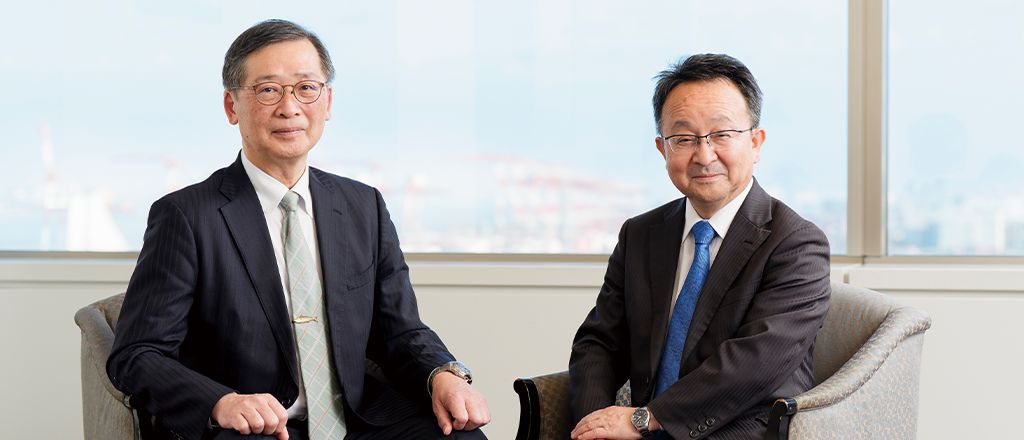
Tadashi Tokai
Professor Emeritus, Tokyo University of Marine Science and Technology (former President of the Japanese Society of Fisheries Science)
Tokai joined the Nansei Regional Fisheries Research Laboratory of the Fisheries Agency in 1984 and has engaged in research at the Tokyo University of Marine Science and Technology since 1991. He contributed to the development of fishery resource management as a professor beginning in October 2000, and also served as President of the Japanese Society of Fisheries Science from May 2022 to May 2026. He has served as Professor Emeritus since April 2024.
Shinya Aoki
President, Representative Director, NICHIMO CO.,LTD.
Aoki joined Nichimo in 1985 and utilized his knowledge of chromosome research in coho salmon aquaculture. Since then, he has been involved in aquaculture businesses for a variety of fish species. After gaining diverse work experience, including serving as President of a Group company, Aoki was appointed Director and Executive Officer in 2022 and then Representative Director and President in June 2024.